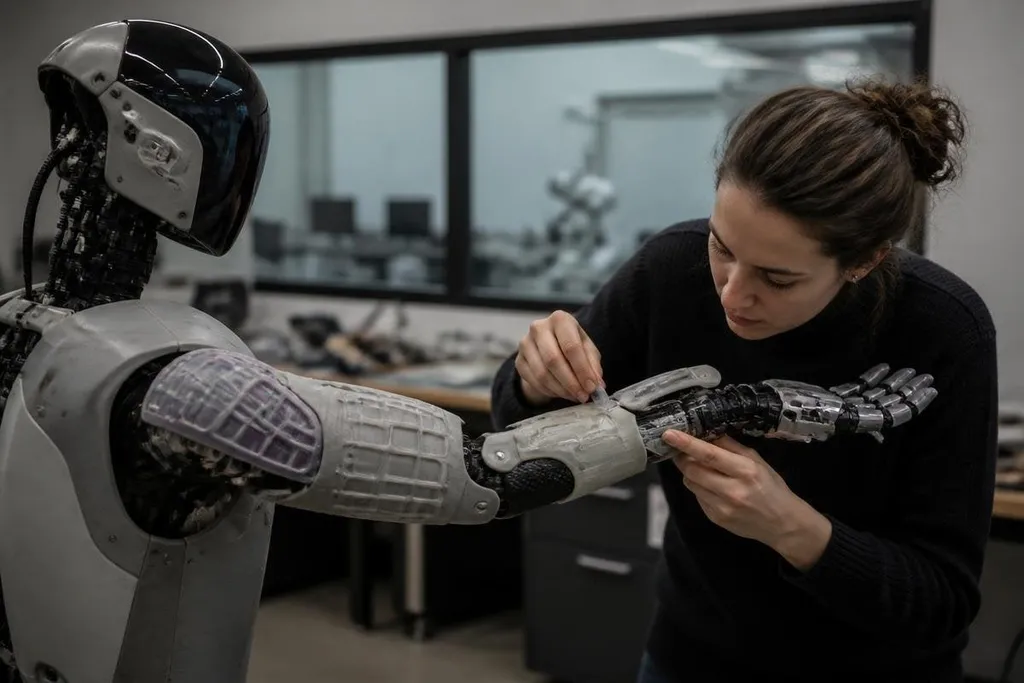
A robot can see a person across a room, but safe contact starts much closer. Artificial robot skin aims to sense pressure, heat, stretch, and contact location across a machine’s body. The hard part is turning those signals into safe movement without making the robot fragile or costly.
Quick read
- Touch sensors must cover curved, moving surfaces without blocking joints.
- A useful skin must separate a light brush from a damaging impact.
- Repair, wiring, and long-term wear may matter more than a soft outer layer.
What artificial robot skin has to sense
Human skin gives the brain several kinds of information at once. Robot skin tries to provide a smaller technical version of that input through sensors placed under or inside a flexible surface.
Pressure tells the robot that something touched its body and how hard that contact was. Stretch sensors show how the surface bends. Temperature sensors can warn about hot objects, while vibration sensors may help identify a sliding or changing grip.
That data matters only when the robot can act on it. A hand that senses rising pressure can reduce motor force. An arm that detects contact near a person can stop or change direction. A mobile robot can use touch along its outer shell to find a wall without relying on cameras alone.
The skin also needs to report where contact happened. A single sensor can say that pressure rose, but a grid of sensors can show the contact area and its movement. That difference affects whether the robot releases an object, slows an arm, or keeps moving.
Why soft surfaces are hard to build
Its outer surface bends, stretches, twists, and takes repeated impacts. The sensors must keep working through that movement, while wires and circuit boards stay connected underneath.
The surface must also fit around joints. A rigid sensor panel may work on a flat torso but fail across an elbow or finger. Flexible materials fit better, yet they can produce changing readings as they age, fold, or collect dust.
Signal quality creates another problem. A sensor may react to force, heat, bending, or electrical noise at the same time. The robot’s software has to sort those inputs before it decides that a person touched the arm or that an object slipped from the gripper.
That decision cannot depend on a single reading. The robot needs a way to check the signal against movement, position, and recent contact. A pressure rise during a planned grasp means something different from the same rise during an unexpected collision.
Safety comes before human-like feel
A soft outer layer can reduce the harm from contact, but softness alone doesn't make a robot safe. The robot still needs limits on motor force, a quick stop, and software that reacts when a person enters its path.
Artificial skin may help with those tasks by giving the control system more contact data. It can also reveal faults that cameras miss, such as a small object pressed against the back of an arm or a cable trapped near a joint.
The open issue is response time and reliability in real work. A demonstration may show a sensor reacting to a touch, but that does not prove the whole robot can stop safely during a fast movement.
That proof also needs to cover months of wear and cases where part of the skin is damaged.
A skin layer that passes one contact test says little about months of use. Dated artificial robot skin reporting can tie a material claim to a named robot and test result, giving the judgment that follows a record beyond a close-up demo.
I wouldn't judge artificial robot skin by how much it resembles human skin. I’d judge it by whether the robot detects contact, makes the correct move, and keeps doing that after repeated use.
Repair may decide the cost
Skin across the hands, arms, or body adds more parts that can fail. A damaged surface may affect sensing even when the motors and frame still work.
That creates practical questions for a factory or lab. Can a technician replace one damaged section? Does the new section need calibration? Can the robot run with a small area offline? Are the sensor readings stable after cleaning and heat exposure?
These details affect the machine’s working life. A skin system that costs little to make but takes hours to replace may cause more downtime than a simpler contact sensor in a few fixed locations.
The best design may vary by task. A warehouse arm could need touch around its gripper and forearm. A care robot may need wider coverage and lower contact force. A research platform may accept shorter service life to test new materials.
A practical test for future systems
Before you treat an artificial skin system as ready for deployment, check these points:
- Contact range: Does it sense pressure, sliding contact, and impact across the areas that matter?
- Control link: Can the robot slow, stop, or change direction from the sensor data?
- Damage response: Does one failed patch leave the robot safe and usable?
- Service work: Can a technician replace and calibrate a section without sending the robot away?
- Long-term data: Has the maker shown readings after repeated bending, cleaning, and contact?
Safe handling doesn't require human-like skin. It needs sensors that keep their readings, software that reacts in time, and a repair plan that fits the job. Until those three pieces are shown together, artificial skin remains a useful research direction rather than a finished answer.